

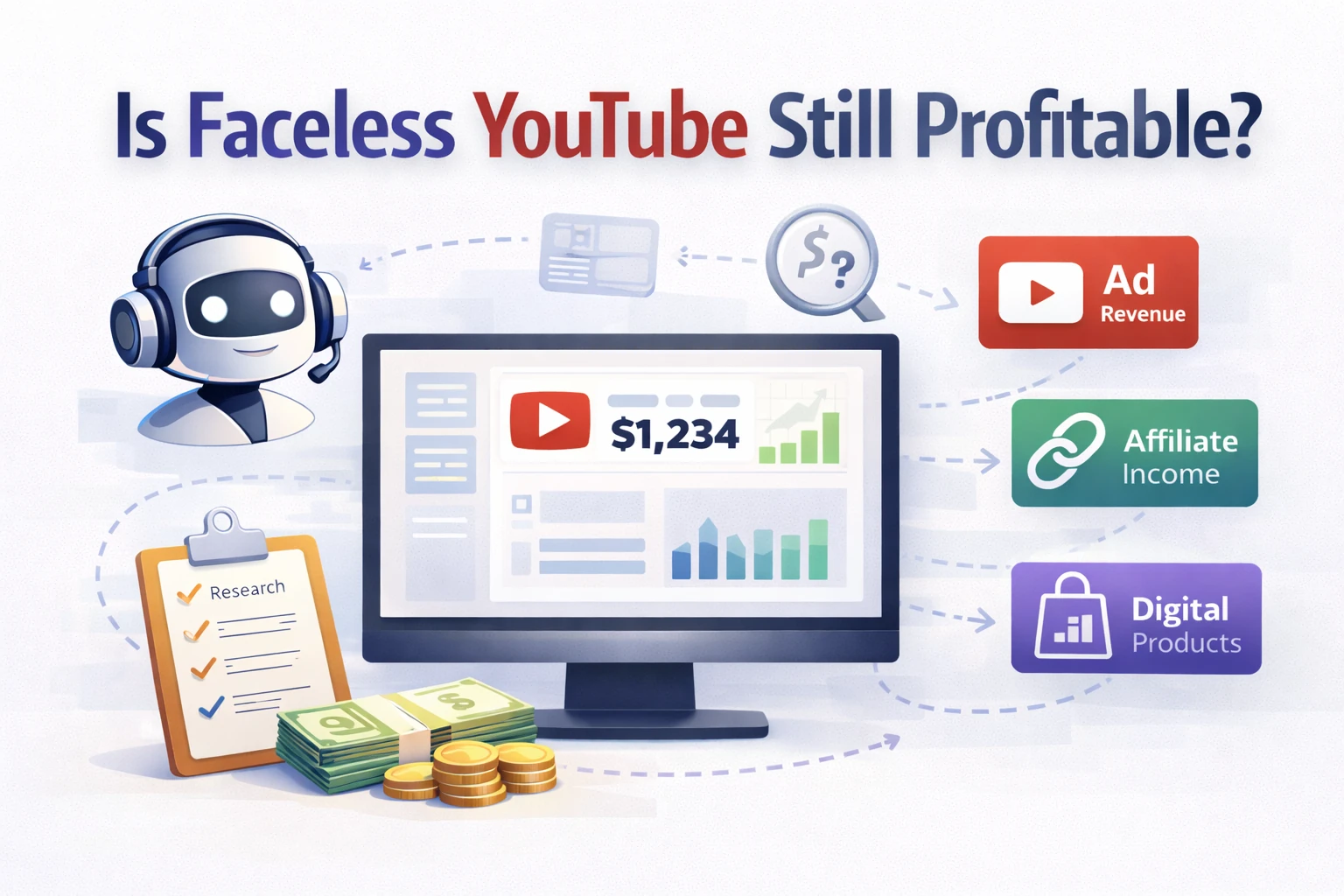
Is Faceless YouTube Still Profitable?
Is faceless YouTube still profitable in 2026, or has the opportunity already peaked? This question appears in nearly every creator forum and AI entrepreneurship discussion. With the rise of automation tools, AI voiceovers, and text-to-video systems, barriers to entry are lower than ever. But lower barriers also mean higher competition.
The short answer: yes, faceless YouTube is still profitable. The longer answer depends entirely on niche selection, production efficiency, and monetization structure. In this guide, we break down profitability from a business perspective — not hype.
Table of Contents
- What changed in faceless YouTube?
- Is faceless YouTube still profitable? A business analysis
- RPM and revenue expectations
- Competition and saturation myths
- Cost structure and margins
- Scalability advantage of AI-assisted production
- Comparison: faceless vs personality-driven channels
- Real risks to consider
- Decision: should you start now?
What changed in faceless YouTube?
Five years ago, faceless channels required outsourcing voice actors, video editors, and scriptwriters. Today, AI tools can automate large parts of production. This shift reduced startup costs but increased competition.
At the same time, YouTube’s algorithm increasingly prioritizes audience retention and viewer satisfaction rather than raw upload frequency. According to YouTube’s own Creator Insider documentation (YouTube Creator updates), watch time and viewer satisfaction signals heavily influence distribution.
This means low-effort, copy-paste faceless channels struggle. Structured, value-driven channels still thrive.
Is faceless YouTube still profitable? A business analysis
To evaluate profitability, treat a faceless channel like a startup. Ask three questions:
- What is the revenue potential per 1,000 views?
- What is the production cost per video?
- How scalable is the workflow?
Profitability equals revenue minus cost, multiplied by scalability.
RPM and revenue expectations
Is faceless YouTube still profitable in terms of ad revenue alone? It depends on niche.
Finance, business, SaaS, and AI content typically generate higher RPMs compared to entertainment or gaming compilations. Data from eMarketer and industry analysts show that business-focused YouTube content attracts stronger advertiser competition (Digital video advertising insights).
But ad revenue is only one layer. Affiliate marketing often becomes the larger income source in AI and software niches.
Competition and saturation myths
Many people claim faceless YouTube is “saturated.” This usually means generic niches like motivational quotes or random top-10 compilations are crowded.
However, YouTube is a search engine. There are thousands of micro-niches with demand but limited structured competition. Profitability comes from targeting specific search intent rather than chasing trends.
Instead of asking whether the model is saturated, ask whether your niche selection is strategic.
Cost structure and margins
Faceless YouTube still profitable? One major advantage is cost efficiency. AI production tools reduce the need for expensive editing software and freelancers.
If you use integrated tools to generate scripts, voiceovers, and visuals, your primary cost becomes software subscriptions rather than labor.
This lowers the breakeven point. Even modest traffic can become profitable if production cost per video remains low.
Scalability advantage of AI-assisted production
Scalability is where faceless channels outperform many personality-driven models. With AI-assisted workflows, you can batch-produce scripts and generate videos efficiently.
For example, AI-powered text-to-video systems allow you to turn written scripts into structured videos without manual timeline editing. If you’re evaluating tools for this workflow, you can explore this breakdown: Fliki for Faceless YouTube Channels.
Scalability compounds. More videos mean more searchable assets, which increases total channel surface area.
Comparison: faceless vs personality-driven channels
Personality-driven channels build deeper audience loyalty but require on-camera presence and personal branding. Faceless channels trade personality for systemization.
Compared to personality channels, faceless models are easier to outsource, automate, and replicate. However, they rely more heavily on topic research and search demand.
Real risks to consider
- Over-reliance on AI without quality control
- Entering low-RPM entertainment niches
- Publishing without clear monetization strategy
- Ignoring audience retention metrics
Profitability decreases when creators focus on automation before strategy.
Decision: should you start now?
Decision: Faceless YouTube is still profitable — but only as a structured, search-driven business model. If you approach it with niche research, layered monetization (ads + affiliate), and scalable production systems, the opportunity remains strong. If you chase trends without differentiation, profitability declines quickly.
For a complete overview of AI tools and strategy frameworks, explore the full hub here: Faceless YouTube Channels with AI.