

Conversational Forms vs Contact Forms
Conversational forms vs contact forms is more than a visual or stylistic choice. The format you use to collect information directly affects how users perceive effort, how many people complete the process, and the quality of the leads you receive.
This article compares conversational forms vs contact forms from a practical, conversion-focused perspective. Instead of debating trends, it focuses on real user behavior and when each approach performs better. For a broader look at how chat-based interfaces are used on websites, you can start here: AI chatbot for website.
Table of Contents
Understanding the two form types
Before comparing conversational forms vs contact forms, it’s important to clearly define what each format represents.
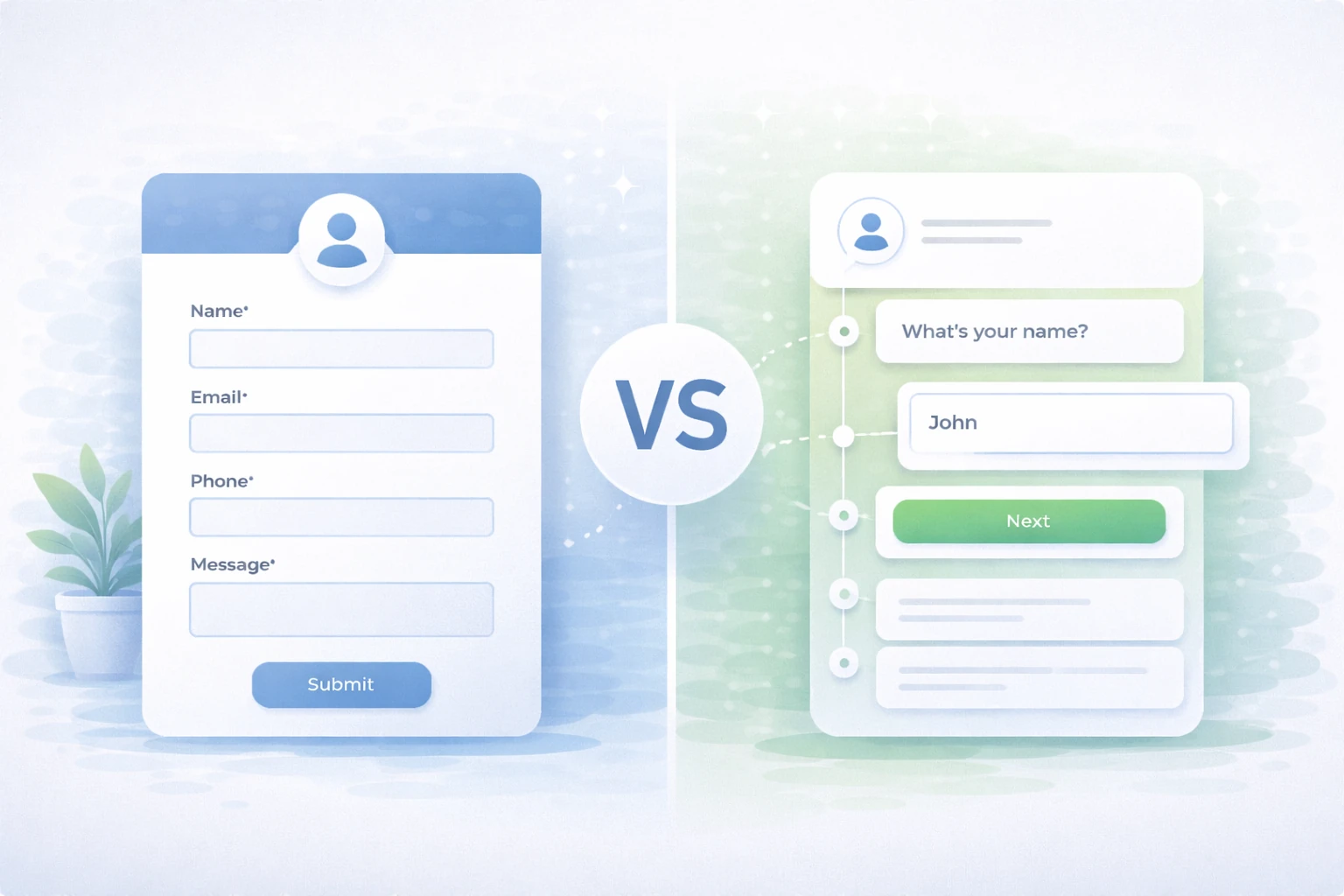
Contact forms are static layouts that display multiple input fields at once. Users scan the form, decide whether the effort is worth it, and then either complete it or abandon it.
Conversational forms collect information through a step-by-step interaction. Questions are presented one at a time, often framed as a conversation rather than a task.
User psychology and perceived effort
The biggest difference between conversational forms vs contact forms lies in how users perceive effort.
When users see a traditional contact form with many fields, they immediately estimate how long it will take to complete. Even if the form is simple, the visual density can feel demanding.
Conversational forms reduce this initial friction by revealing questions gradually. Users focus on one decision at a time, which often feels easier and less overwhelming.
This progressive disclosure approach is commonly discussed in UX research around form design and cognitive load, including usability studies published by organizations like the Nielsen Norman Group.
Conversational forms vs contact forms
At a functional level, conversational forms vs contact forms differ in how information is requested and processed.
- Contact forms: users see all required fields upfront.
- Conversational forms: questions appear sequentially.
- Interaction: conversational forms feel guided, while contact forms feel transactional.
- Error handling: conversational forms can correct input immediately.
These differences influence both completion rates and user satisfaction.
Impact on conversion rates
In the conversational forms vs contact forms debate, conversion rate is often the main metric.
Conversational forms tend to perform better when the number of required inputs is moderate to high. By breaking the process into smaller steps, they keep users engaged longer.
However, for very short forms—such as email-only signups—traditional contact forms may convert just as well, if not better, due to their simplicity.
This means conversational forms are not a universal replacement, but a strategic alternative depending on context.
Lead quality and intent
Beyond raw conversion rates, conversational forms vs contact forms also affect lead quality.
Conversational flows allow you to ask qualifying questions before collecting contact details. This helps filter out low-intent users and focus on more relevant leads.
Traditional contact forms often collect information first and qualify later, which can result in higher volume but lower intent.
Tools built specifically for conversational lead capture—such as Collect.chat for lead generation—are designed to support this qualification-first approach.
Implementation and maintenance considerations
Another important factor in the conversational forms vs contact forms decision is maintenance.
Contact forms are easy to maintain but rigid. Any change requires redesigning the form layout.
Conversational forms require more initial planning but are often easier to adapt over time. Questions can be added, removed, or reordered without redesigning the entire interface.
That flexibility becomes valuable as campaigns evolve and lead qualification criteria change.
Decision: which form type should you use?
Decision: Conversational forms work best when you want to reduce perceived effort, guide users step by step, and qualify leads before collecting contact details. Traditional contact forms remain effective for simple, low-friction data collection. In many cases, the best solution is to use both, depending on page intent and user context.
If you’re exploring tools designed specifically for conversational data collection, you can review one example here: Collect.chat for lead generation.