

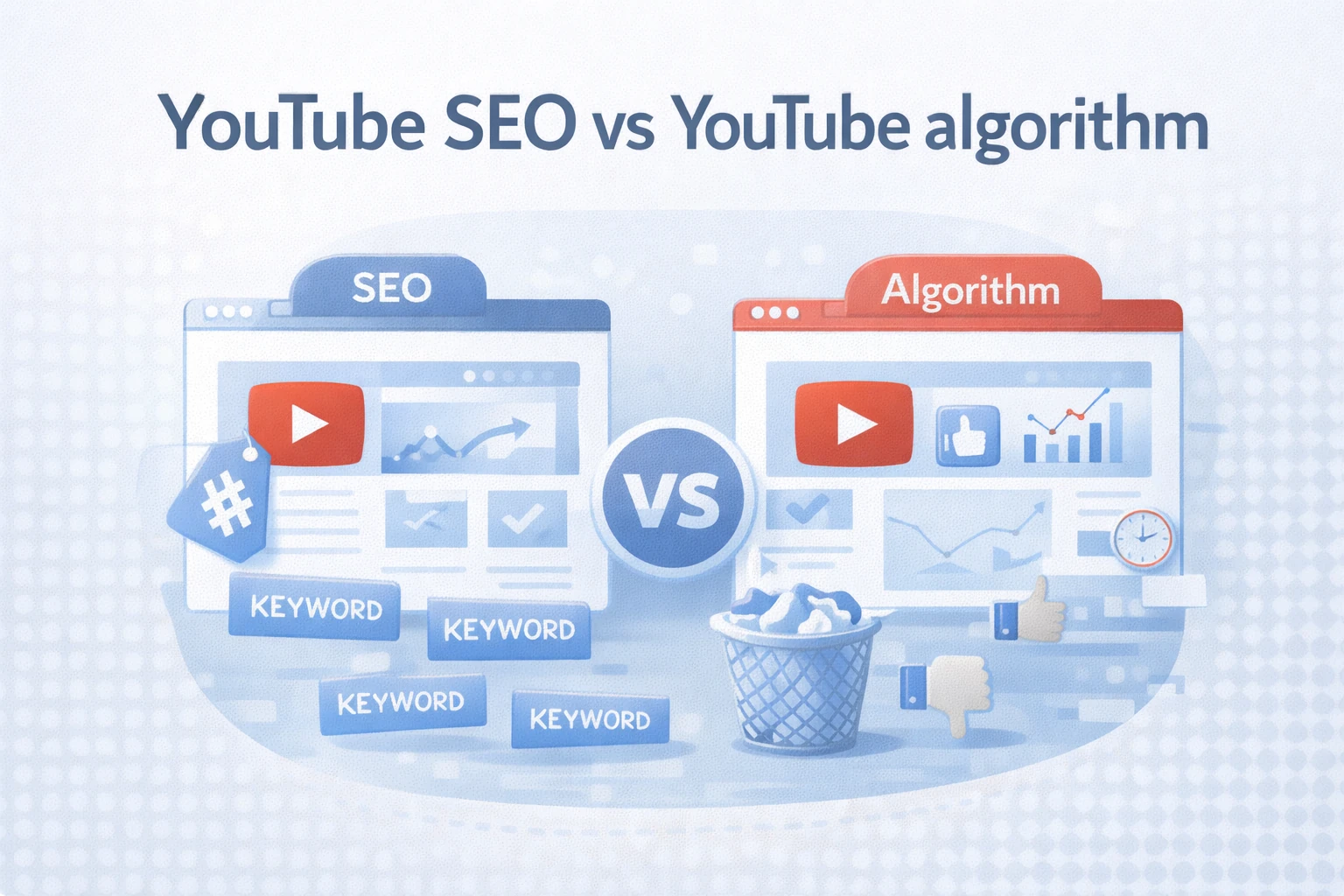
YouTube SEO vs YouTube algorithm
Creators often talk about “doing SEO” and “pleasing the algorithm” like these are two competing strategies. That confusion causes wasted effort, scattered priorities, and inconsistent results. If you want stable growth, you need a clear mental model of youtube seo vs youtube algorithm: what each one does, where they overlap, and what they cannot do for you.
This support guide explains youtube seo vs youtube algorithm in a practical way for small and mid-sized channels. You’ll learn which actions improve discoverability, which ones improve distribution, and how to combine them without chasing myths or “tricks.”
Table of Contents
- Why people mix them up
- YouTube SEO vs YouTube algorithm
- What YouTube SEO actually does
- What the YouTube algorithm actually does
- How SEO and the algorithm work together
- What to focus on first (small channels)
- Comparison mention: search optimization vs recommendation performance
- Decision: the simplest strategy that works
Why people mix them up
The reason these 2 things are confusing is that creators experience YouTube as one black box: you upload, you optimize a few things, and then views either happen or they don’t. Tutorials add to the confusion by promising certainty: “Add these tags,” “Use this keyword formula,” “Do this one trick.” When creators follow those steps and still don’t grow, they assume SEO is dead or the algorithm is unfair.
In reality, YouTube has multiple discovery surfaces (search, suggested, browse/home, notifications, external) and each surface responds to different signals. That’s why the correct framing is not “SEO or algorithm,” but youtube seo vs youtube algorithm as two different layers of the same system.
YouTube SEO vs YouTube algorithm
Here’s the cleanest way to understand youtube seo vs youtube algorithm:
- YouTube SEO helps YouTube understand what your video is about and which searches it should appear for.
- The YouTube algorithm decides how widely to distribute your video based on viewer behavior and satisfaction.
SEO is mainly about relevance and clarity. The algorithm is mainly about performance and satisfaction. That distinction is the core of youtube seo vs youtube algorithm, and it immediately explains why “perfectly optimized” videos can still flop: if people click and leave, distribution stops.
What YouTube SEO actually does
YouTube SEO is your way of labeling and framing the video so YouTube can place it correctly. Think of SEO as “topic matching.” The best SEO actions reduce ambiguity. YouTube should be able to answer: What is this video about? Who should care? What search intent does it satisfy?
Practical SEO levers include:
- Title: clear topic + implied benefit (not keyword stuffing).
- Description: context, related terms, and a clean outline of what viewers will learn.
- Tags: small supporting signals for spelling variants, related entities, and context.
- Spoken words + captions: YouTube can interpret language signals beyond metadata.
- Topical consistency: a channel that repeatedly covers a niche becomes easier to classify.
That’s the “SEO side” of youtube seo vs youtube algorithm: you help YouTube categorize your video, so it has a chance to appear for relevant searches and “related” placements.
SEO works best for content people actively search for: tutorials, reviews, comparisons, fixes, and problem-solving. If nobody searches for the topic, SEO can’t create demand—it only helps match existing demand.
What the YouTube algorithm actually does
The “algorithm side” of youtube seo vs youtube algorithm is what happens after discovery. Once your video gets impressions (search results, suggested, browse/home), YouTube observes how viewers respond. Distribution expands when YouTube sees that viewers are satisfied.
Key performance signals typically include:
- Click-through rate (CTR): your title + thumbnail promise is compelling.
- Watch time and retention: viewers stick around after clicking.
- Session impact: does the viewer keep watching more videos after yours?
- Satisfaction signals: likes, comments, surveys (where applicable), and fewer negative actions.
So if you’re stuck wondering why “SEO didn’t work,” the algorithm explanation is usually simple: the video may have been correctly categorized, but viewers didn’t respond strongly enough for YouTube to scale it.
If you want a stable reference from YouTube itself about how discovery works, this official overview helps: YouTube search and discovery systems. It reinforces why youtube seo vs youtube algorithm is not a battle—it’s categorization plus performance.
How SEO and the algorithm work together
Once you understand youtube seo vs youtube algorithm, the workflow becomes straightforward:
- SEO gets you the right first impressions (relevant searchers and related audiences).
- The algorithm decides whether you deserve more impressions (based on viewer response).
A video can be “SEO-strong” and still fail if the hook is weak, the pacing drags, or the content doesn’t deliver what the title promised. Conversely, a video can be highly engaging but fail to get initial traction if YouTube can’t classify it properly or you’re competing in a brutally broad topic.
This is exactly why tools and workflows matter. A tool won’t magically “beat the algorithm,” but it can reduce guesswork in the SEO layer—especially for topic selection and keyword intent. If you want a practical breakdown focused on that workflow, this is your goldmine: vidIQ for YouTube SEO.
What to focus on first (small channels)
For small channels, the best way to apply youtube seo vs youtube algorithm is to prioritize the “minimum viable SEO” and then obsess over viewer response. Here’s a simple priority stack that avoids wasted time:
- Topic selection: pick topics with clear search intent and realistic competition.
- Title + thumbnail package: win the click honestly (clear promise, not clickbait).
- First 15–30 seconds: confirm the promise fast; remove long intros.
- Structure: deliver answers in steps; avoid rambling.
- SEO polish: description context, a few tags for clarity, consistent vocabulary.
If you do these well, you stop treating youtube seo vs youtube algorithm like a mystery. SEO becomes your targeting system. The algorithm becomes your scoreboard.
Comparison mention: search optimization vs recommendation performance
Compared to search optimization alone, recommendation performance is what creates scale. Search traffic is usually steadier and more predictable; recommendation traffic can be explosive but requires stronger packaging and retention. This is another reason youtube seo vs youtube algorithm matters: search helps you start, performance helps you grow.
If you rely only on SEO tactics, you may get impressions but not distribution. If you rely only on “algorithm hacks,” you may get spikes but no consistency. The best creators blend both layers deliberately.
Decision: the simplest strategy that works
Decision: Treat youtube seo vs youtube algorithm as a two-step system. First, use SEO to make your topic and intent crystal clear. Then, earn distribution by improving clicks, retention, and satisfaction. If you do only one of those steps, results will be unstable.
For most small channels, the fastest path is not “more optimization.” It’s better topic selection, stronger packaging, and tighter delivery—supported by SEO tools that reduce guesswork. If you want a practical tool-based workflow, start here: vidIQ for YouTube SEO.
If you’re deciding how VidIQ fits into a faceless YouTube strategy, this overview walks through the full process from idea generation to publishing. Faceless YouTube strategy with AI tools.