
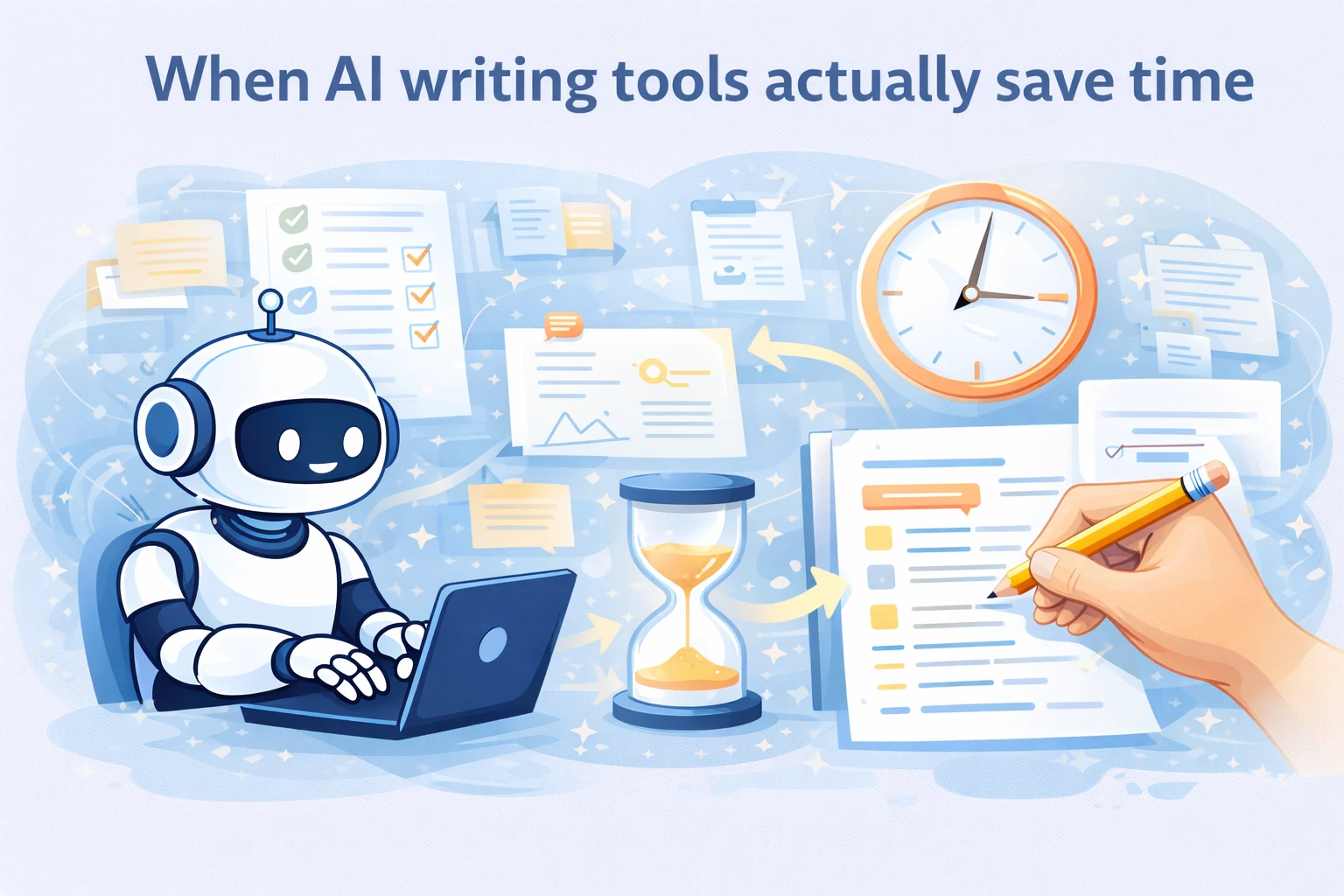
When AI writing tools actually save time
AI writing tools are often marketed as massive time-savers, but many freelancers and small teams discover that reality is more nuanced. Sometimes AI speeds things up dramatically. Other times it creates extra editing work that cancels out the benefits. Understanding when AI writing tools actually save time is critical if you want to build an efficient, sustainable content workflow.
This support article breaks down the situations where AI genuinely improves productivity, where it does not, and how to structure your workflow so AI works for you instead of against you.
Table of Contents
Why AI doesn’t always save time
Before looking at when AI writing tools actually save time, it’s important to understand why they sometimes fail to do so. AI-generated text is fast, but speed alone does not equal productivity.
If AI output is vague, repetitive, or off-tone, the time spent rewriting can exceed the time saved during drafting. This is especially true when AI is used for tasks that require judgment, originality, or deep subject expertise.
In other words, AI saves time only when the task matches the tool’s strengths.
When AI writing tools actually save time
The clearest cases of when AI writing tools actually save time share a common pattern: the output is allowed to be imperfect, and human review is built into the process.
AI works best when it replaces mechanical effort rather than thinking. If your goal is to reduce blank-page time, generate variations, or structure ideas quickly, AI can cut hours from your workflow.
High-impact time-saving use cases
The following scenarios consistently demonstrate when AI writing tools actually save time for freelancers and small teams.
Outlines and content planning
Creating outlines is a surprisingly time-consuming task. AI can generate multiple outline options in minutes, allowing you to choose a structure and move straight into drafting.
This removes decision fatigue early in the process and keeps momentum high.
First drafts and rough sections
Drafting sections is one of the most reliable answers to when AI writing tools actually save time. Generating rough versions of introductions, explanations, or FAQs gives you something concrete to improve instead of starting from scratch.
The key is to edit decisively rather than polish endlessly.
Short-form content and variations
AI shines when you need multiple versions of short content: ad headlines, social captions, CTA lines, or product descriptions. Generating 10–20 variations at once is where AI provides real leverage.
Human selection plus light editing is far faster than manual brainstorming.
Repurposing existing content
Repurposing content is another clear example of when AI writing tools actually save time. Transforming blog posts into summaries, newsletters, or social posts works well because the original content already contains your voice.
This aligns well with how natural language generation systems operate: pattern-based transformation rather than original reasoning.
Hidden time costs of AI writing
To understand when AI writing tools actually save time, you must also recognize hidden costs. Over-editing, second-guessing, and prompt tweaking can quickly erode efficiency.
If you spend more time refining prompts than editing content, AI may not be the right tool for that task. Clear boundaries prevent productivity loss.
Comparison mention: AI writing tools vs manual writing
Compared to manual writing, AI writing tools offer speed but require oversight. Manual writing is slower upfront but often faster for highly specialized or opinion-driven content.
This comparison shows that AI is most effective as a complement, not a replacement.
Decision: is AI worth it for your workflow?
Decision: AI writing tools actually save time when they are used for drafting, planning, and variation-heavy tasks. They waste time when used for final positioning, deep expertise, or sensitive messaging.
For freelancers and small teams, tools like Rytr are most effective when treated as drafting assistants rather than autonomous writers. A full breakdown of this workflow is available here: Rytr AI review.
To better understand where Rytr fits compared to other AI writing tools and SEO-driven platforms, we summarized the key differences in this guide. Comparison of AI writing and SEO content tools.