

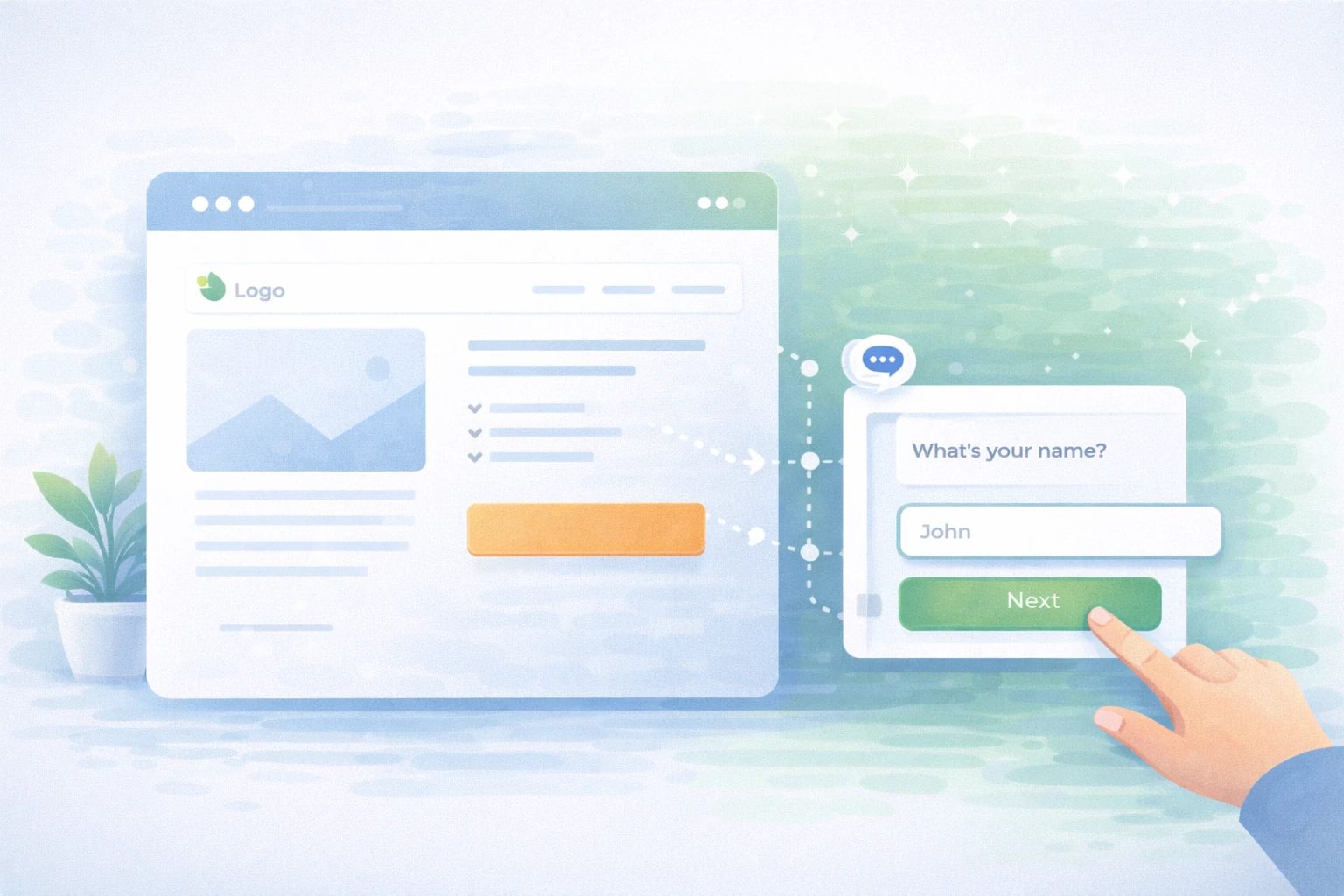
Website Chatbot for Landing Pages
A website chatbot for landing pages is increasingly used to improve conversion rates by replacing or supporting traditional lead capture elements. Instead of relying solely on static forms, chatbots introduce interaction at the exact moment when visitors decide whether to engage or leave.
This article explains how a website chatbot for landing pages works in practice, when it improves performance, and when it can actually hurt conversions if used incorrectly. For a broader understanding of chatbot roles across websites, you can start here: AI chatbot for website.
Table of Contents
Why landing pages are different
Landing pages are designed around a single goal: conversion. Unlike regular website pages, they remove distractions and guide visitors toward one specific action.
This focused environment means every element must justify its presence. A website chatbot for landing pages therefore needs to support the primary goal rather than compete with it.
If a chatbot introduces confusion, delays, or cognitive overload, it can easily reduce conversion rates instead of improving them.
Why use a chatbot on landing pages?
The main reason to use a website chatbot for landing pages is friction reduction. Traditional forms often ask users to commit upfront, which can feel demanding—especially on mobile devices.
A chatbot breaks this commitment into smaller steps. Users answer one question at a time, which feels less intrusive and easier to complete.
This interaction-based approach aligns well with conversion optimization principles commonly discussed in CRO communities such as CXL’s conversion research.
Website chatbot for landing pages in action
A website chatbot for landing pages performs best when it has a clear, limited role.
Lead capture
Chatbots can replace contact forms entirely by collecting essential details through a short conversation. This is especially effective when more than two or three fields are required.
Lead qualification
Instead of collecting contact information immediately, a chatbot can ask qualifying questions first. This improves lead quality and reduces follow-up workload.
Objection handling
Some visitors hesitate because they lack information. A chatbot can answer common questions directly on the landing page, preventing premature exits.
Conversational tools built specifically for lead capture—such as Collect.chat for lead generation—are often used in these focused landing page scenarios.
Impact on conversions and bounce rate
When implemented correctly, a website chatbot for landing pages can increase conversion rates by keeping users engaged longer.
However, aggressive chatbot triggers can have the opposite effect. If a chatbot appears too early or interrupts reading, it may increase bounce rates.
Successful implementations carefully balance visibility with restraint, allowing users to initiate interaction when they are ready.
Placement and timing considerations
Placement is critical for a website chatbot for landing pages.
- Bottom-right placement is familiar and less intrusive
- Delayed triggers reduce interruption
- Scroll-based triggers align with user intent
Timing should always respect the primary message of the landing page rather than competing with it.
Limitations and risks
A website chatbot for landing pages is not always the best solution.
- Very short forms may outperform chatbots
- Some users prefer traditional input fields
- Poorly designed conversations can reduce trust
Testing is essential. A/B comparisons between chatbot and form-based versions often reveal which approach performs better for a specific audience.
Decision: should landing pages use chatbots?
Decision: A website chatbot for landing pages makes sense when lead capture requires multiple inputs, qualification matters, and user hesitation is common. For simple signups, traditional forms may still be more efficient. The strongest landing pages often use chatbots selectively, not universally.
If you’re evaluating conversational tools designed for landing page lead capture, you can review one option here: Collect.chat for lead generation.