

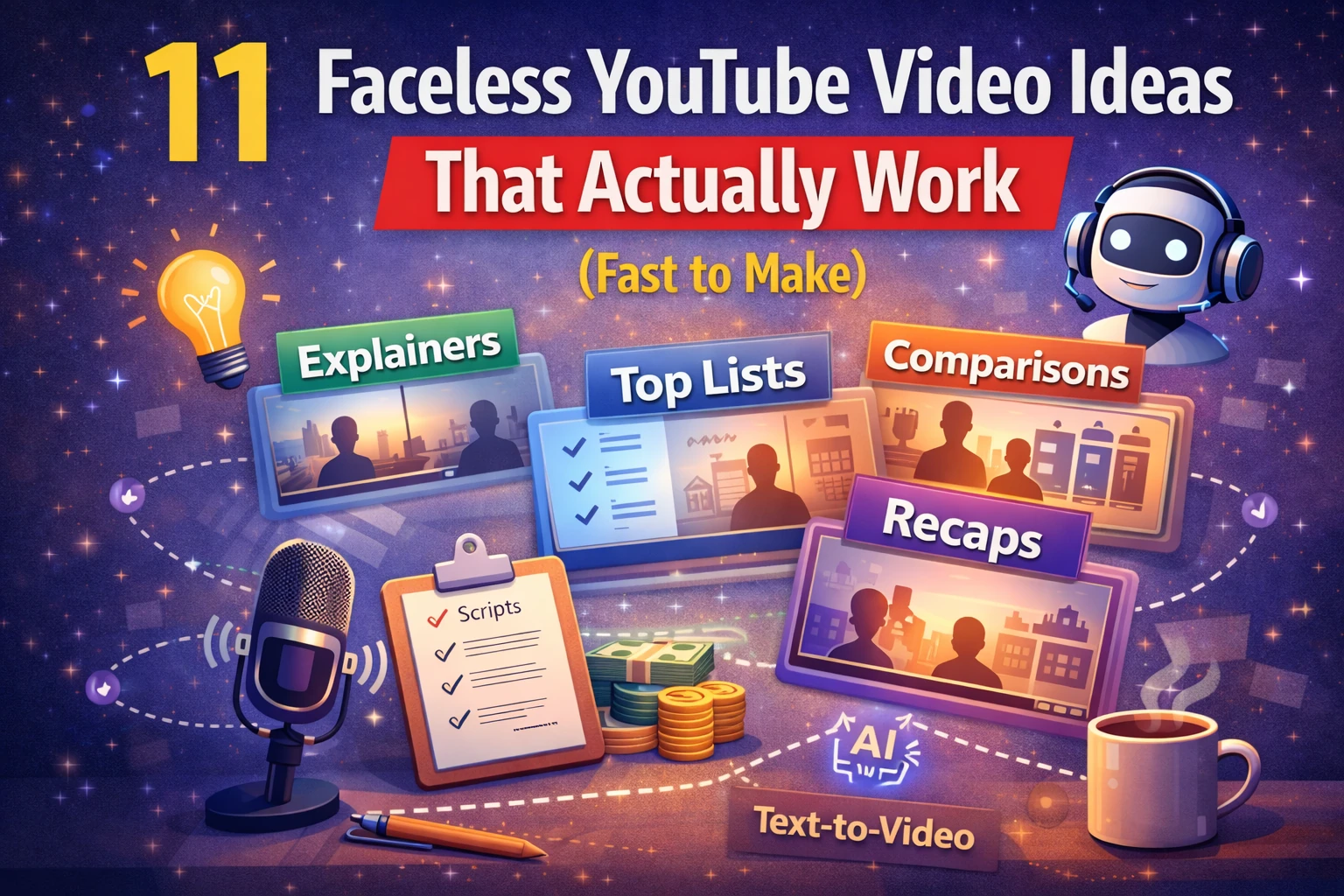
Faceless YouTube Video Ideas
Faceless YouTube video ideas are everywhere — but most lists are either too generic (“make top 10 videos”) or too hard to execute consistently. The real challenge is picking faceless YouTube video ideas that are (1) easy to produce without a camera, (2) searchable, and (3) monetizable without relying on viral luck.
This guide is built for creators who want a repeatable system. You’ll get category-level ideas you can publish weekly, plus a simple way to turn each idea into a script + voiceover + visuals using AI tools (including Fliki). It’s not about “creative inspiration” — it’s about output and consistency.
Table of Contents
What makes a faceless idea worth publishing?
Before you collect faceless YouTube video ideas, filter them. A “good” idea for faceless channels usually has at least two of these three traits:
- Search intent: people actively look for it (“how to…”, “best…”, “vs…”, “review…”).
- Repeatable structure: you can produce it in batches without reinventing the format.
- Monetization fit: the topic naturally supports ads, affiliate links, or digital products.
If you’re building a channel for long-term growth, prioritize search-driven ideas. The YouTube Creator Academy emphasizes audience retention and consistent value delivery as core growth levers, which is much easier when your format is repeatable and your topic matches what viewers want. (YouTube Creator Academy resources)
Faceless YouTube video ideas you can scale
Here are faceless YouTube video ideas grouped into scalable “buckets.” The goal is to pick one bucket and publish 10–20 videos before switching. This helps the algorithm understand your content and makes scripting much faster.
1) Explainers and “how it works” videos
- “What is X and how does it work?” (AI tools, finance concepts, tech terms)
- “X explained in 5 minutes”
- “Beginner mistakes with X”
- “X checklist for beginners”
These ideas are perfect for text-to-video formats and don’t require a personality-led presentation. You can narrate over simple visuals, stock footage, or screen recordings.
2) Top lists (but with a twist)
- “Top 7 tools for [specific use case]”
- “Top 5 workflows for [specific outcome]”
- “3 options under $X (and who each is for)”
- “Best X for beginners vs advanced users”
List videos work best when the angle is specific. “Top AI tools” is too broad; “Top AI tools for faceless YouTube scripts” is more searchable and easier to monetize.
3) Comparisons and “which should you choose?”
- “X vs Y: which is better for beginners?”
- “X vs Y: best for speed vs best for quality”
- “Free vs paid: what you actually get”
- “Best alternative to X (and why)”
This bucket is strong because it’s decision-driven. Viewers are already close to taking action, which often improves affiliate conversion rates.
4) Recaps, summaries, and “news with context”
- Weekly AI updates (3–5 key points)
- “What happened with X (and what it means)”
- “New feature breakdown in 2 minutes”
These can work well as faceless videos, but they’re less evergreen. Use them as a secondary series, not your core growth engine.
High-intent formats that monetize well
If you want revenue potential (not just views), prioritize formats that naturally include tools, workflows, or outcomes. Examples:
- “How to do X faster” (automation, templates, tools)
- “Best tool for X” (tool reviews and comparisons)
- “X workflow” (step-by-step tutorials)
- “Mistakes to avoid” (decision support)
These are the easiest faceless YouTube video ideas to scale because each video can reuse a similar structure and CTA placement.
If your channel is built around AI-assisted production, Fliki is one of the tools that can cover narration + visuals in one workflow. Here’s the full breakdown: Fliki for Faceless YouTube Channels.
A simple AI production system (script → voice → video)
Once you choose your faceless YouTube video ideas, your production system matters more than creativity. This is a reliable workflow for consistent output:
- Pick 10 titles in one bucket. Don’t mix niches in the first month.
- Write scripts in batches. Use the same structure (hook → points → example → takeaway).
- Generate narration. Use AI voiceover to remove recording friction.
- Build visuals. Stock footage, slides, simple animations, or text-to-video scenes.
- Publish consistently. Even 2–3 videos/week beats random bursts.
For context: many creators discuss whether reused stock footage can lead to “reused content” issues. YouTube’s own support documentation explains monetization policies and how content must add value through editing, narrative, and original structure. (YouTube Partner Program policies)
Comparison mention: faceless search content vs viral entertainment
Compared to viral entertainment formats (memes, compilations, random trends), faceless search-driven content is slower at the start — but it compounds. Viral videos spike and fade; searchable tutorials and explainers can bring views for months or years.
If your goal is a channel that behaves like an asset, faceless YouTube video ideas built around search intent are usually the smarter path.
Decision: which ideas should you start with?
Decision: Start with one bucket you can execute for 30 days without burning out. For most beginners, explainers and comparison videos are the best starting point because they’re script-friendly, AI-friendly, and monetizable.
If you want a complete strategy covering multiple AI video generators (not only Fliki), use this hub as your roadmap: Faceless YouTube Channels with AI.