
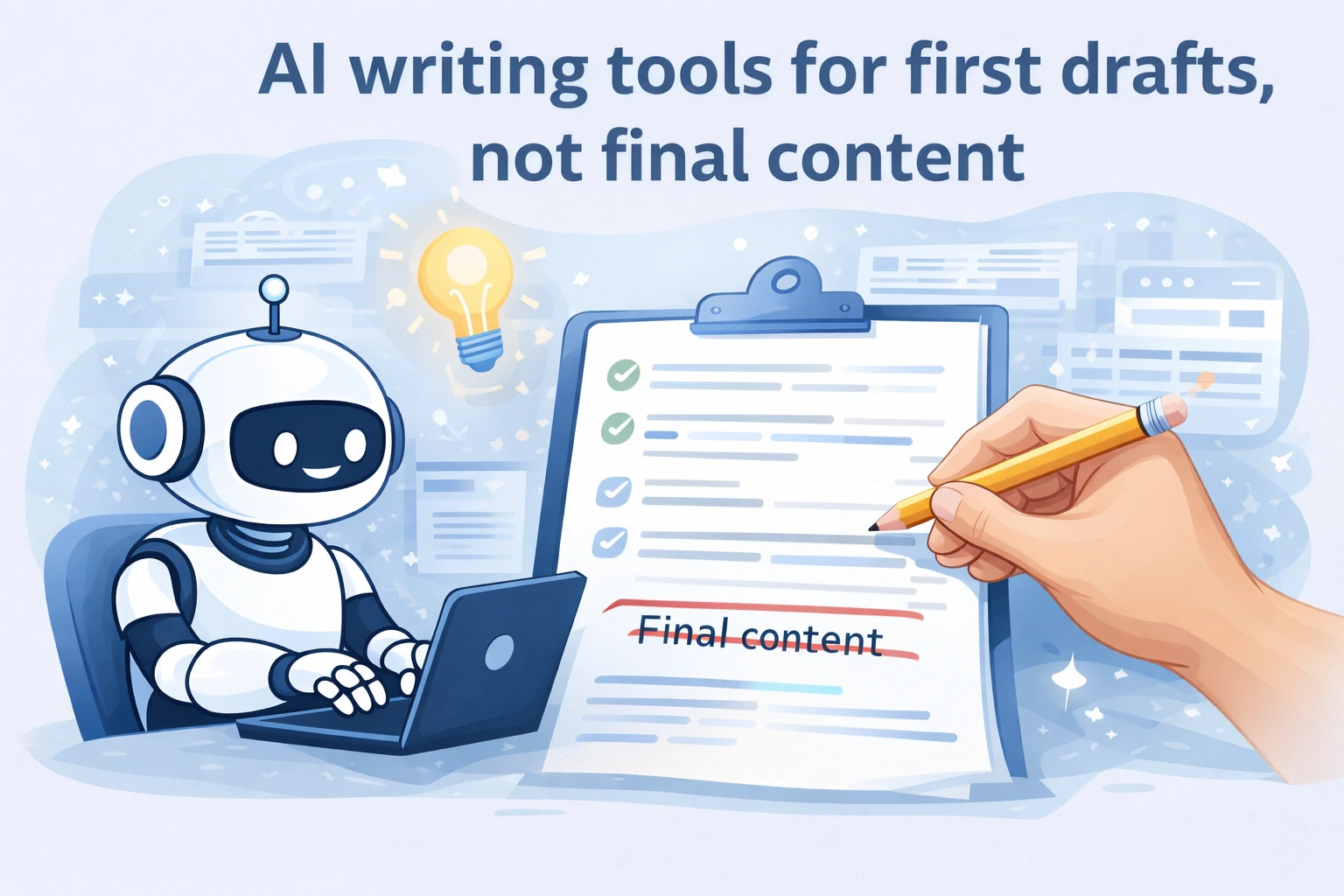
AI writing tools for first drafts, not final content
AI writing tools have become a standard part of modern content workflows. They allow freelancers and small teams to move from idea to draft in minutes instead of hours. However, many creators learn the hard way that AI writing tools for first drafts do not always produce content that is ready to publish. Understanding where AI fits best in the process is critical for maintaining quality, originality, and credibility.
This article explains why AI writing tools work best as draft generators rather than final content creators, and how to use them without sacrificing long-term content performance.
Table of Contents
Why AI drafts feel finished but aren’t
One reason many creators misuse AI writing tools is that the output appears polished at first glance. Sentences are grammatically correct, transitions exist, and the structure looks complete.
This creates a false sense of readiness. AI-generated drafts often lack depth, specificity, and original perspective. The content reads smoothly but does not provide unique value, which becomes a problem for both readers and search engines.
This limitation comes from how language models generate text. As explained in natural language generation, AI systems prioritize statistical patterns and fluency, which often results in content that feels complete but lacks originality or depth.
AI writing tools for first drafts
The most effective way to use AI writing tools is for first drafts. In this role, AI accelerates ideation and helps overcome blank-page syndrome without replacing human judgment.
AI writing tools for first drafts are especially useful for outlining, generating alternative phrasings, and producing rough versions of sections that can later be refined. This allows creators to focus their energy on editing, examples, and positioning.
When used this way, AI becomes a productivity layer rather than a content substitute.
Where AI writing tools fall short
Despite their usefulness, AI writing tools struggle with several aspects of final content creation. These limitations explain why AI writing tools for first drafts should not be relied on for finished articles.
- Original insight: AI cannot provide lived experience or firsthand expertise.
- Strong opinions: AI tends to avoid clear stances, resulting in neutral, forgettable content.
- Contextual judgment: AI lacks awareness of audience sophistication and intent.
- Brand voice: Consistent tone across content requires human oversight.
These gaps become especially visible in competitive niches where differentiation matters.
How to turn AI drafts into publish-ready content
Using AI writing tools for first drafts effectively requires a structured follow-up process. The draft should be reviewed for gaps, enriched with examples, and adjusted for tone and intent.
Adding constraints, real-world scenarios, and clear recommendations transforms generic AI output into valuable content. This step is where most of the competitive advantage is created.
Tools like Rytr fit well into this workflow by providing fast draft generation while leaving creative control with the human editor.
For deeper guidance on content quality, Google’s official documentation on creating helpful, people-first content reinforces the importance of originality and usefulness.
Comparison mention: AI drafts vs human-written content
Compared to fully human-written content, AI drafts offer speed but lack depth and intent awareness. Human writers naturally adapt tone, prioritize relevance, and introduce unique viewpoints.
This comparison highlights why the strongest workflows combine AI efficiency with human judgment rather than choosing one over the other.
Decision: the right role for AI in content creation
Decision: AI writing tools are most effective when used for first drafts, not final content. Treating AI as a drafting assistant preserves speed while protecting content quality and long-term performance.
For freelancers and small teams, Rytr provides a reliable way to generate drafts quickly without locking you into generic output. You can explore how this fits into a real-world workflow here: Rytr AI review.
Rytr works well for fast content generation, but it’s not always clear when an SEO-focused tool is needed. This overview breaks down the differences. How AI writing and SEO tools differ.