AI chatbot for website
If you’re considering an AI chatbot for website use, you’re likely facing one of a few common challenges: visitors can’t find answers fast enough, the same questions keep reaching your inbox, or contact forms fail to convert consistently. A well-designed website chatbot helps reduce these friction points by guiding users toward the information or action they are already looking for.
Website chatbots are no longer limited to large companies or complex support systems. Today, even small and mid-sized websites use them to improve usability, support response time, and lead capture -without adding more pages or manual work.
Table of Contents
- What is an AI chatbot for website?
- When a website chatbot actually helps
- Three website chatbot approaches
- YourGPT: content-trained website chatbot
- FastBots AI: simple FAQ and navigation chatbot
- Collect.chat: conversational lead generation
- Comparison mention: chatbots vs FAQs, forms, and live chat
- Decision: which AI chatbot should you choose?
- Implementation checklist
What is an AI chatbot for website?
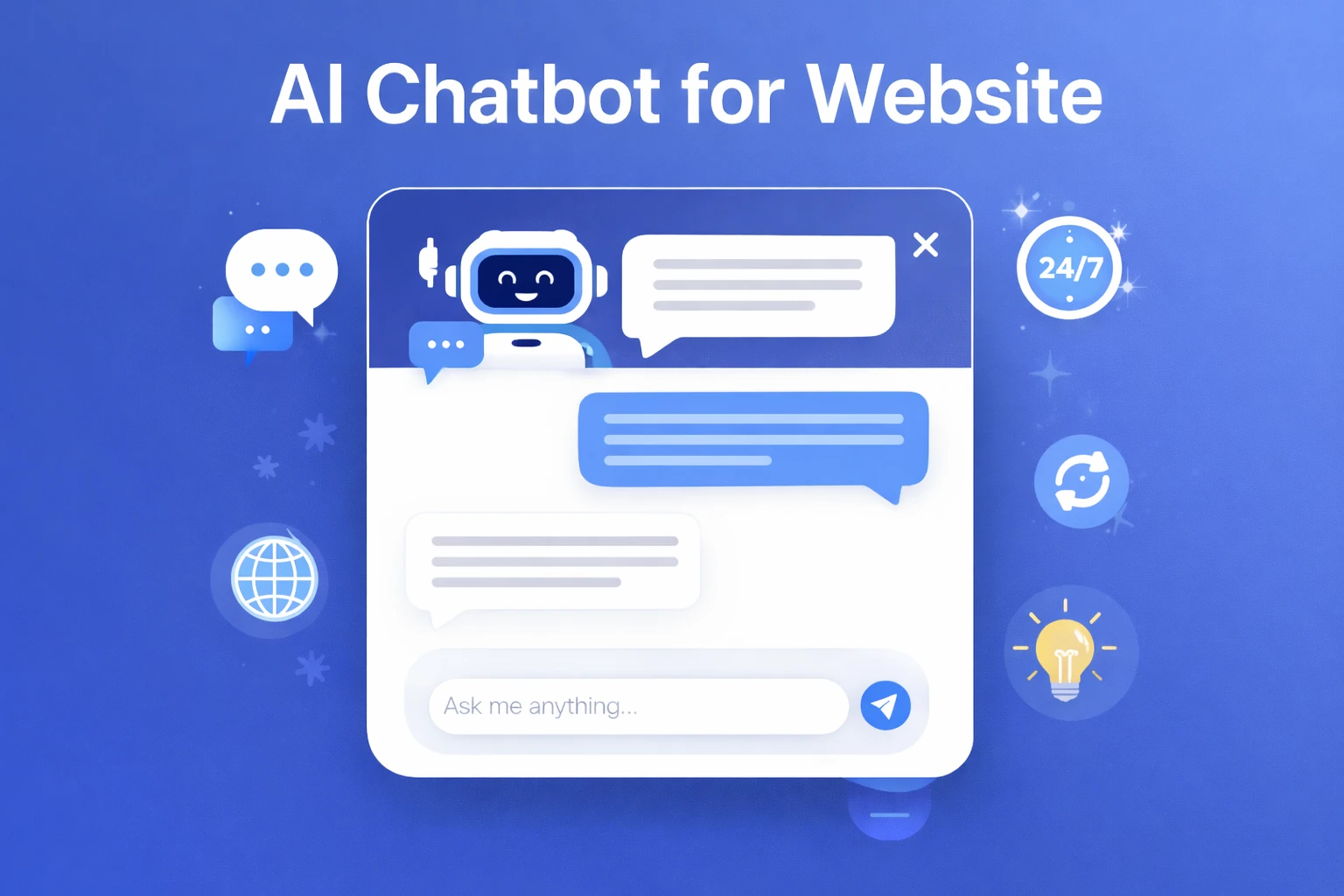
An AI chatbot for website use is an embedded assistant that allows visitors to interact with a site using natural language or guided conversations. Instead of navigating menus or scanning long pages, users can ask questions directly or follow a short dialogue to reach the next step faster.
In practical terms, a website chatbot acts as an interface layer between your content and your visitors. It does not replace your website—it helps users access what already exists with less effort.
Most website chatbots fall into one of two categories:
- Content-trained chatbots that answer questions using your website pages, documentation, or uploaded resources.
- Conversational lead chatbots that guide visitors through structured questions to capture contact details or qualify inquiries.
This difference matters because each type of AI chatbot for website use solves a very different problem. Choosing the wrong one often leads to disappointing results.
When a website chatbot actually helps
An AI chatbot for website environments works best when it removes an existing bottleneck. Based on common implementation patterns, website chatbots tend to deliver value when at least one of the following situations applies:
Your website already explains things well
If your site already contains solid explanations but visitors still struggle to find them, a content-trained chatbot can surface the right answers instantly. Instead of rewriting pages, you improve access to what is already there.
You receive repetitive questions
Many support and pre-sales inquiries follow predictable patterns. A website chatbot can act as a first layer that handles common questions and directs users to relevant pages, while more complex issues still reach a human.
Your forms underperform
Traditional contact forms often feel impersonal and tedious. Conversational chatbots replace multi-field forms with step-by-step questions, which can improve completion rates by keeping users engaged.
In these cases, an AI chatbot for website use does not change your offer—it improves how visitors interact with it.
Three website chatbot approaches
Not all website chatbots work the same way. The tools discussed below represent three distinct approaches, each designed for a specific type of interaction.
YourGPT: content-trained website chatbot
YourGPT focuses on building chatbots that are trained directly on your own website content, documents, and knowledge base. When visitors ask questions, the chatbot responds using the information you provide rather than generating generic answers.
This type of AI chatbot for website use is particularly effective for SaaS websites, service businesses, and content-heavy platforms where accuracy and consistency matter.
Learn more here: YourGPT for website chatbot.
FastBots AI: simple FAQ and navigation chatbot
FastBots AI takes a similar content-based approach but focuses on simplicity and fast setup. It is designed to help visitors find answers and navigate a website without complex configuration or advanced workflows.
This makes FastBots AI a practical AI chatbot for website use on small business sites, marketing pages, and informational platforms.
Detailed overview: FastBots AI for website chatbot.
Collect.chat: conversational lead generation
Collect.chat approaches the problem from a different angle. Instead of open-ended questions, it uses conversational flows to replace traditional contact and inquiry forms.
This AI chatbot for website lead generation is especially effective on landing pages and service sites where the primary goal is capturing leads rather than providing detailed answers.
Marketing-focused use cases: Collect.chat for lead generation.
Comparison mention: chatbots vs FAQs, forms, and live chat
Compared to FAQs, an AI chatbot for website use allows visitors to ask questions in natural language instead of scanning headings. Compared to static forms, conversational chatbots guide users step by step. And compared to live chat, website chatbots focus on availability and predictable questions, while human agents remain better suited for complex or sensitive issues.
For broader experience-based perspectives, communities such as Reddit’s productivity subreddit and Quora’s chatbot discussions provide useful insights.
Decision: which AI chatbot should you choose?
Decision: Choose Collect.chat if your main goal is lead generation and form replacement. Choose YourGPT or FastBots AI if your priority is helping visitors find accurate answers from your existing website content. The right AI chatbot for website use depends on whether your primary need is answers or conversions.
Implementation checklist
- Define one clear goal before adding a website chatbot.
- Use high-quality content when training content-based bots.
- Keep responses short and link to relevant pages.
- Review unanswered questions regularly.
- Plan a handoff to human support when needed.
From here, you can explore the detailed guides linked above or browse the full AI chatbot reviews category.