

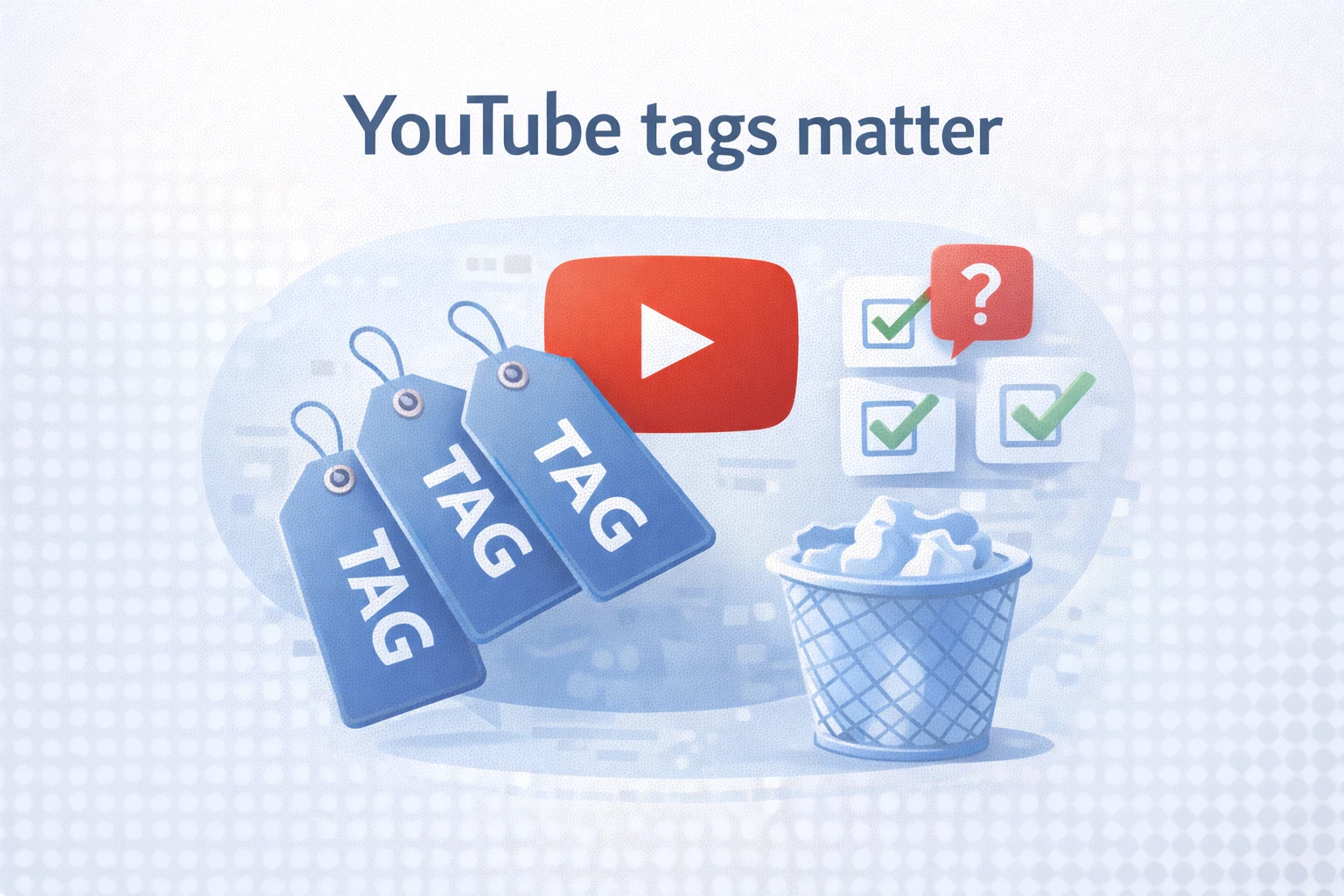
YouTube tags matter – 5 facts creators often misunderstand
YouTube tags are one of the most debated elements of YouTube SEO. Some creators believe tags are essential for ranking, while others claim they are completely useless. The truth sits in between. Understanding whether youtube tags matter requires separating outdated advice from how YouTube actually interprets content today.
This support guide explains what YouTube tags are designed to do, why their importance changed over time, and how creators should treat them in a modern SEO workflow—without wasting time or ignoring them entirely.
Table of Contents
Why YouTube tags are still discussed
The reason creators still ask whether youtube tags matter is historical. In the early years of YouTube, tags played a larger role because the platform relied more heavily on metadata to understand video topics.
At that time, automatic transcription, contextual analysis, and behavioral modeling were far less advanced. Tags acted as a shortcut for classification. As YouTube evolved, its reliance on tags decreased—but the advice never fully disappeared.
This gap between old tutorials and modern systems is what keeps the debate alive.
YouTube tags matter
The accurate answer is yes—youtube tags matter, but only in specific and limited ways. Tags no longer drive rankings directly, and they cannot compensate for weak content or poor engagement.
Instead, tags function as a supporting signal. They help YouTube interpret context when other signals are unclear, incomplete, or conflicting.
If your title, description, spoken content, and viewer behavior already align, tags contribute very little. If those signals are ambiguous, tags can reduce misclassification.
What YouTube tags are actually for
To understand why youtube tags matter less than they once did, it helps to understand their original purpose. Tags were designed to provide additional keyword context—especially for spelling variations, alternate names, and related terms.
Today, YouTube extracts meaning from many other sources:
- video titles and descriptions
- spoken words and captions
- viewer interaction patterns
- channel-level topical consistency
Because these signals are stronger, tags are treated as supplementary metadata rather than a ranking lever.
YouTube itself emphasizes this behavior-first approach in its documentation on search and discovery systems, where metadata is described as a way to understand content—not to override viewer satisfaction.
Cases where YouTube tags help
There are still situations where youtube tags matter more than average. These are edge cases where context is harder to infer.
- Brand names with multiple spellings: tags help reinforce variations.
- Homonyms or ambiguous topics: tags clarify which meaning applies.
- New channels: limited historical data makes extra context useful.
- Strong accents or transcription errors: tags reinforce intended keywords.
In these cases, tags help YouTube categorize content correctly, which can improve initial discovery.
Cases where YouTube tags have little impact
Just as important as knowing when youtube tags matter is recognizing when they don’t.
- clear titles and descriptions
- high retention and watch time
- strong click-through rates
- established topical channels
In these situations, spending excessive time optimizing tags produces negligible results. Viewer behavior overwhelmingly outweighs tag relevance.
Comparison mention: tags vs stronger SEO signals
Compared to thumbnails, titles, and retention, tags are a low-impact signal. A small improvement in click-through rate or watch time has a far greater effect on distribution than perfect tag optimization.
This comparison explains why experienced creators treat tags as maintenance, not strategy.
Decision: how much effort should tags get?
Decision: Use tags to clarify, not to rank. If you understand where youtube tags matter, you can spend minutes—not hours—on them.
Creators who want structure without obsession often rely on SEO tools to identify which tags add context and which can be skipped. Platforms like VidIQ help creators apply tags consistently without over-optimizing.
You can see how tags fit into a broader optimization workflow here: vidIQ for YouTube SEO.
When used with the right expectations, tags quietly support discovery. When misunderstood, they quietly waste time.
To understand how VidIQ works alongside other AI tools used for faceless YouTube channels, this practical guide covers the bigger picture. Faceless YouTube channels with AI.