
Why AI-written content sounds generic
AI writing tools have dramatically lowered the barrier to content creation. Freelancers, marketers, and small teams can now generate blog posts, landing pages, and emails in minutes. Yet a common complaint keeps surfacing: the content looks correct, but it feels bland, repetitive, and interchangeable. Understanding why AI-written content sounds generic is essential if you want to benefit from AI speed without sacrificing credibility or originality.
This article explains the structural reasons behind generic AI output, why this happens even with “good” prompts, and how content creators can fix the problem without abandoning AI writing tools entirely.
Table of Contents
- How AI writing tools actually work
- Why AI-written content sounds generic
- The statistical averaging problem
- Lack of context, experience, and constraints
- How templates amplify repetition
- How to reduce generic AI output
- Comparison mention: AI writers vs human editing
- Decision: using AI without losing originality
How AI writing tools actually work
To understand why AI-written content sounds generic, it helps to understand how AI writing tools generate text. These tools do not “think” or reason about a topic. Instead, they predict the next most likely word based on patterns learned from vast amounts of training data.
This approach prioritizes fluency and probability. The result is text that reads smoothly and avoids obvious errors, but also tends to rely on widely used phrasing. AI systems are designed to be safe and broadly acceptable, not distinctive or opinionated.
This limitation is widely discussed in creator and SEO communities like Reddit’s r/SEO, where users often notice that AI-generated articles across different websites share similar tone and structure.
Why AI-written content sounds generic
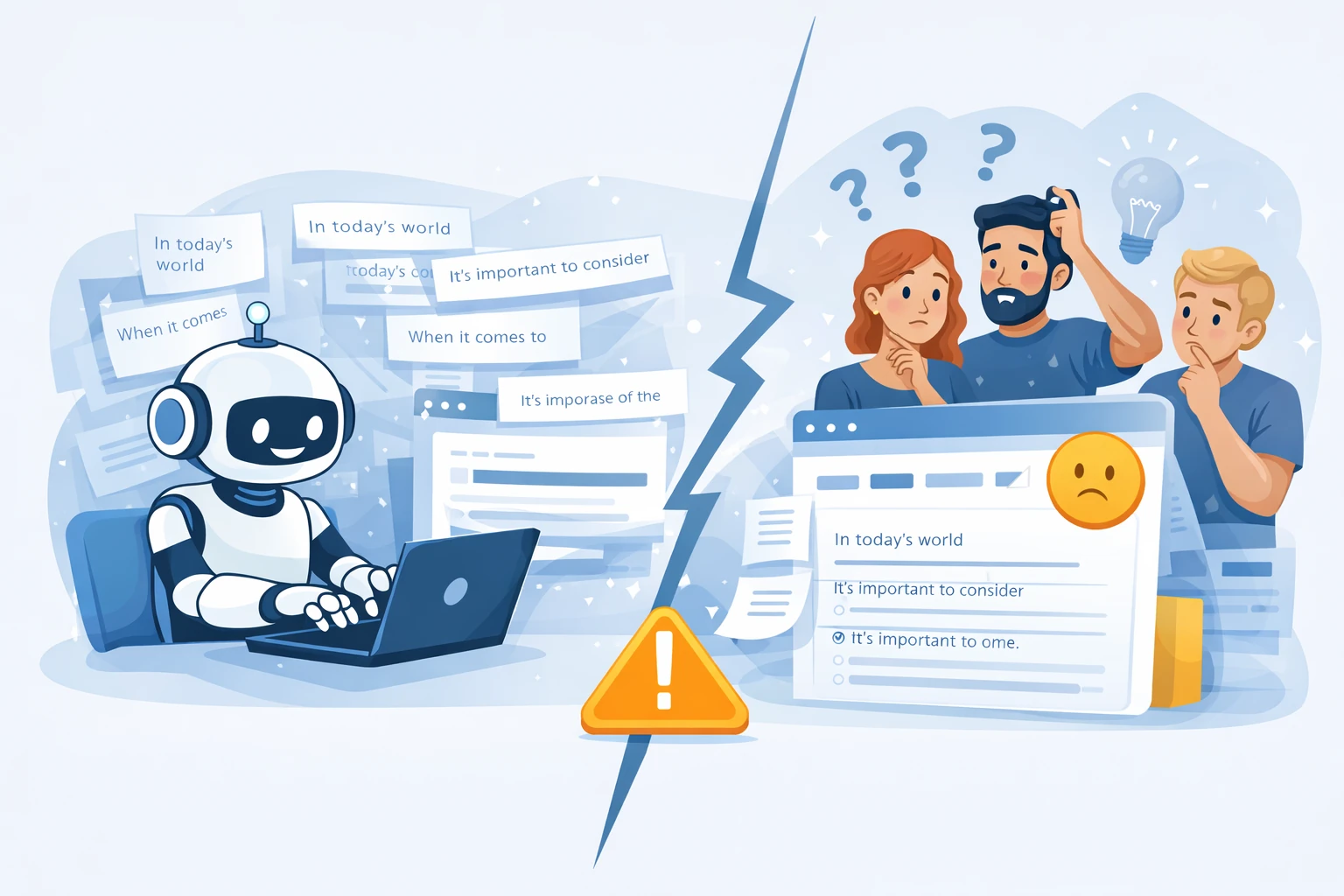
The core reason why AI-written content sounds generic is that AI optimizes for average outcomes. It produces text that is statistically likely to be acceptable to many readers rather than uniquely valuable to a specific audience.
When an AI tool generates content, it avoids extremes. It rarely makes strong claims, introduces unconventional ideas, or challenges assumptions unless explicitly instructed to do so. This results in content that feels safe, neutral, and ultimately forgettable.
The statistical averaging problem
One overlooked reason why AI-written content sounds generic is statistical averaging. AI models are trained on millions of examples, and their outputs reflect the most common patterns found in that data.
This means uncommon perspectives, niche experiences, and strong opinions are naturally diluted. Even when prompts differ slightly, the underlying probability engine pushes the output toward familiar phrasing.
As a result, two different users asking similar questions often receive content that feels eerily alike, despite being generated independently.
Lack of context, experience, and constraints
Another reason why AI-written content sounds generic is the absence of real-world constraints. Human writers draw from experience, limitations, failures, and trade-offs. AI does not.
Without explicit instructions, AI lacks awareness of audience sophistication, brand voice, or situational nuance. This often leads to content that explains concepts correctly but fails to resonate emotionally or practically.
How templates amplify repetition
Templates are powerful productivity tools, but they also contribute to why AI-written content sounds generic. When users repeatedly rely on default templates, the structure and phrasing become predictable.
Common symptoms include identical introductions, generic transitions, and vague conclusions. Over time, this repetition becomes obvious to readers and search engines alike.
Google’s guidance on creating helpful, original content consistently highlight template overuse as a core issue.
How to reduce generic AI output
Fixing why AI-written content sounds generic does not require abandoning AI. Instead, it requires changing how AI tools are used within the workflow.
Effective strategies include adding constraints, specifying audience details, and injecting personal experience after generation. Treating AI output as a draft rather than final content allows creators to layer originality on top of speed.
Tools like Rytr are most effective when used for fast ideation and drafting, with the expectation that human editing will refine tone, examples, and perspective.
Comparison mention: AI writers vs human editing
Compared to human writers, AI writing tools excel at speed and consistency but struggle with originality and judgment. Human editing introduces context, specificity, and intentional emphasis that AI cannot reliably generate on its own.
This comparison highlights why AI should augment human creativity rather than replace it.
Decision: using AI without losing originality
Decision: If differentiation and brand voice matter, AI writing tools should be treated as drafting assistants, not final authors. The most effective workflow combines AI speed with human refinement.
For freelancers and small teams, Rytr provides a practical way to generate first drafts quickly while preserving flexibility for creative editing. You can explore how this approach works in practice here: Rytr AI review.
If you’re using Rytr as your main AI writing assistant, this guide explains how pure writing tools compare to SEO-focused content platforms in real workflows. AI writing tools vs SEO content tools.